
Notes From an Emotional Archaeologist
I always show up and speak the truth
Pay good attention to what comes through
And I’Il lay down my swords tonight
What’ll be will be, alright.
In the middle of a Social Studies lesson, one of my students raised her hand and asked me, completely out of nowhere, “Is pussy a bad word?”
I was teaching a group of six- and seven-year-olds.
Six. Seven.
Yes, I know.
Apparently even my classroom demographics are a meme now.
There are moments in education when all your years of professional experience really come together. You stand there in front of a group of children, rapidly assessing your pedagogical options while simultaneously trying to remember how exactly we got from rules, society and responsible citizenship to pussy.
“Well,” I said eventually, “it depends where you use it.”
Which, now that I think about it, is a surprisingly good answer to most things in life.
Is pussy a bad word? Depends on the context. Is drinking alone bad? Depends whether you’re depressed at home on a Tuesday afternoon or drinking Jaloviina from a champagne glass at the edge of the Barents Sea. Is getting into a truck with a strange man you’ve never met before a bad idea? Almost certainly.
Did I do it?
Obviously.
Context matters.
Unfortunately, I Started Digging
Over the past few years, I have developed an unfortunate hobby.
Emotional archaeology.
Some people have experiences. I excavate them. Something unpleasant happens to a normal person and they think, Well, that was shit, and then apparently they make pasta, watch Netflix and carry on with their lives. I arrive at the site with a metaphorical headlamp, several tiny brushes and the determination of a woman who will not rest until she has established exactly which childhood experience caused her to be mildly irritated by a text message on Tuesday.
Why did that hurt? Why did I react like that? Why did I choose that? Was that love? Fear? Childhood? Motherhood? Attachment? Some ancient wound? Menopause? Was Mercury in bloody retrograde?
There must be an answer.
So I dig.
Over the summer I watched The Dig, about the excavation at Sutton Hoo, where something buried for centuries is carefully uncovered and suddenly the past has something to say to the present. I found this deeply inspiring, which was unfortunate because I was already perfectly capable of digging up things that probably should have been left underground.
Give me one emotional bone fragment and I can reconstruct an entire failed civilisation.
And I have been doing exactly that. Looking backwards, examining things, trying to understand why I am the way I am and why other people were the way they were. Motherhood alone has provided enough archaeological material to keep several universities funded. Childhood could probably qualify for UNESCO protection. Then there are all the choices, mistakes, fears and different versions of myself scattered around the excavation site.
Somewhere during all this digging, though, I noticed something slightly embarrassing. I was sometimes still editing my own stories for an imaginary audience. Would someone think I sounded bitter? Would someone recognise themselves? Would somebody think I hadn’t moved on?
Then came the rather inconvenient thought that if somebody who is no longer in your life is still determining how you tell your life, they are, technically, still in it.
Fuck that.
The past can keep its characters. I don’t need them anymore. I can keep what I learned without dragging the entire cast into every new episode like some emotionally exhausted soap opera that should have been cancelled three seasons ago.
And once I stopped digging for other people, I started finding something else.
Me.
Unfortunately, she turned out to be a hermit.
The Social Part Is Becoming Optional
I’ve always considered myself a social hermit.
I like people. Some of my best friends are people. I can be extremely social, I talk to strangers, I work with children all day, and I genuinely enjoy company.
I also genuinely enjoy it when everybody goes home.
Recently, though, I’ve started wondering whether the social part is becoming optional.
Perhaps this is what happens when you finally become emotionally healthy and self-aware. You spend years reflecting, analysing and working on yourself until eventually your greatest ambition is for everybody to leave you alone.
Then I went hiking alone in northern Norway for two and a half weeks.
Not “alone” in the Instagram sense, where you take a photograph of yourself looking contemplatively at a mountain and then return to a hotel buffet.
Alone.
There were stretches when the last human being I saw was the one I saw when I started walking, and the next one appeared only when the hike ended.
And I loved it.
A Belgian Woman Told Me a Secret
At the beginning of my first hike on Sørøya, after the ferry had dropped me off, I noticed a woman nearby. She was Belgian and came to Norway regularly. She asked whether I was going hiking.
“Yes.”
“How long?”
“Five days.”
We talked for a while, and then she looked at me and said something along the lines of, “Okay. I think I can trust you.”
This is an interesting thing to hear from a complete stranger immediately before disappearing alone into the Arctic landscape.
She told me there was a hytte at the northern tip of the island. It wasn’t marked on the map. It was apparently an incredible place, with a fireplace and everything you might need, but getting there wasn’t easy. The terrain was steep and exposed, and if the weather turned bad, getting back could become dangerous.
Then she told me the important part.
Water.
The final place to collect water was quite far from the hytte. If I decided to go there, I needed to remember that.
Then we went our separate ways.
Days later, towards the end of the hike, I decided to find the secret hytte. When I reached the final water source, there was a warning sign confirming exactly what the Belgian woman had told me.
This was it.
No more water for a long way.
I stood there with my backpack and remembered her warning about the weather. I was on an island in the Barents Sea. I had read enough warnings about how quickly conditions could change, and I knew that if the weather became bad while I was out at the northern tip, I might not be able to leave.
So I did something extremely unlike my usual it’ll probably be fine approach to life.
I took enough water for two days.
This turned out to be one of my better decisions.
The next day, the storm came.
And I stayed there for two nights.
A woman I had spoken to for perhaps a few minutes at the beginning of my hike had disappeared completely from my life, yet days later her words were still there, helping to keep me safe.
Sometimes a stranger leaves you with a story.
Sometimes she leaves you with enough water.
When Nobody Talks to Me, Nature Does
It was midsummer, and I was alone in a secret hytte at the northern edge of Sørøya, looking out over the Barents Sea while a storm had temporarily cut me off from everything else.
Naturally, I had brought Jaloviina.
I may be willing to hike alone through remote Arctic landscapes, but I do have standards.
The hytte had champagne glasses.
So there I was on midsummer night, with a fire outside, drinking Jaloviina from a champagne glass and looking at the Barents Sea.
There was nobody to talk to.
And then the seals appeared.
Something that looked very much like a dolphin appeared too. I am not claiming any scientific expertise here. It may have been a dolphin. It may have been a porpoise. It may have been some marine mammal taking one look at the Finnish woman drinking Jaloviina alone from crystalware and deciding to keep a safe distance.
Whatever it was, it stayed around.
The seals stayed around.
The fire burned and the sea moved, and I realised that I hadn’t spoken to another human being for days, but somehow it didn’t feel silent.
When nobody talked to me, nature did.
I didn’t need anyone to arrive. I wasn’t waiting for the next person. I wasn’t enduring solitude until civilisation resumed. I was exactly where I wanted to be.
And this, I think, was where I first began to dig up the social hermit.
She wasn’t sad.
She wasn’t lonely.
She wasn’t bravely learning how to enjoy her own company.
She was drinking Jaloviina and watching seals.
She was having an excellent time.
Which made what happened whenever she returned to civilisation even more ridiculous.
Unfortunately, Humanity Returned
Later in the trip, I needed to organise transport to the starting point of another hike near Nordkapp. There had been a mistake with my hostel booking, so I called the owner. We sorted out the booking and then, because I am apparently incapable of ending a telephone conversation once its official purpose has been completed, we started chatting.
I happened to ask whether there was public transport to my trailhead.
No.
“But actually, I know a Finnish truck driver who might be able to help you.”
Of course he did.
I had travelled all the way to the northern edge of Norway and the solution to my transportation problem was apparently a random Finnish man with a full-sized truck.
This is the kind of coincidence that makes you wonder whether the universe is looking after you or simply entertaining itself.
Shortly afterwards I was sitting high above the road in an enormous truck with a Finnish man I’d never met before, heading towards the place where I was about to disappear into the wilderness again.
We exchanged phone numbers in case something happened, which seemed like an excellent safety precaution apart from the minor detail that I had just voluntarily climbed into a stranger’s truck.
We agreed on the arrangement.
Five days. Twelve o’clock. Same place.
Then I walked away.
Five days later, I came back to the road.
And there he was.
Twelve o’clock.
With the truck.
He had remembered.
And he gave me a can of beer.
At that particular moment I was prepared to nominate him for sainthood.
After the hike I finally got back, had one glorious shower and was settling into that wonderful post-hike state where you’re clean, exhausted and no longer required to carry your own house on your back when my phone rang.
It was the truck driver.
He had bought six steaks, and apparently it felt stupid to eat steak alone. Would I like to join him?
Now, there are sensible women who would carefully analyse a proposition like this. They would consider personal safety, boundaries and the possible implications of accepting dinner from a strange truck driver in northern Norway.
I am also a woman who analyses things.
I just tend to do it afterwards.
“Why not?”
And so, after spending days happily alone in the wilderness, I found myself eating steak and drinking beer with a Finnish truck driver I had acquired through a Norwegian hostel owner.
The Emotional Archaeologist had the evening off.
She was busy eating.
Five Words and a Piss Bucket
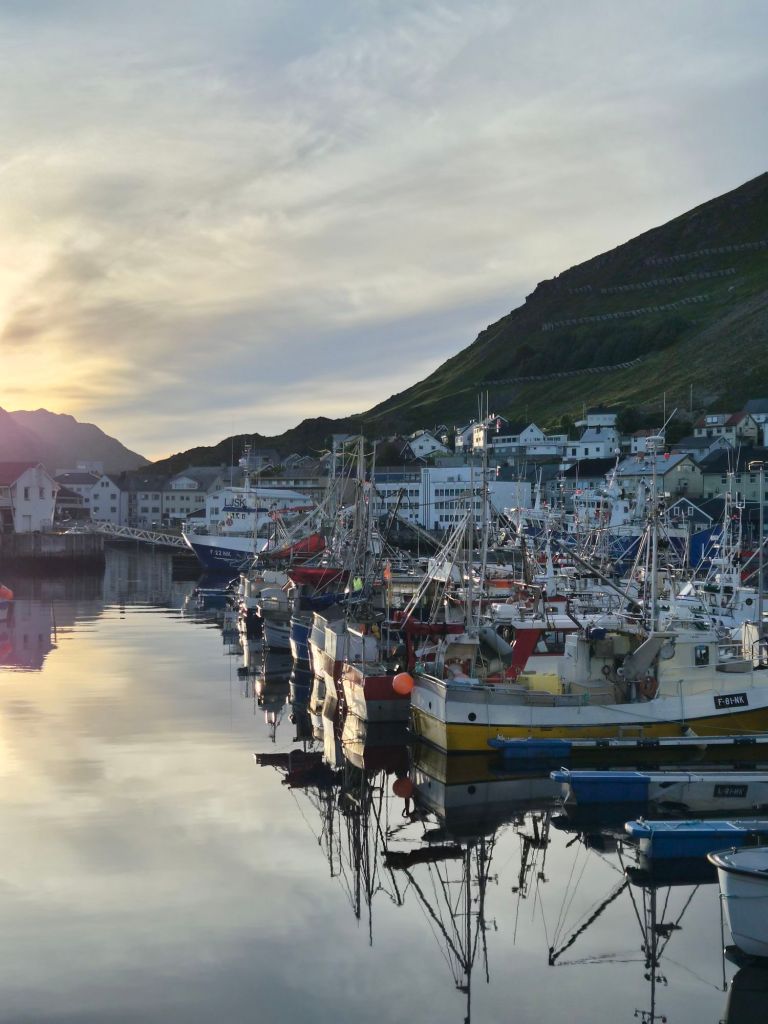
Later I went to Honningsvåg because I wanted to see what passes for a town when you’ve gone that far north. I was sitting alone having a beer when I noticed two men nearby with coffee and buns, and then I heard them speaking Finnish.
I couldn’t resist.
“Ah, the essentials. Kahvi ja pulla.”
Five words.
That’s all it took.
They immediately asked me to join them, so I sat down for coffee and pulla, and two hours later I had somehow acquired an invitation to go fishing with them the following day.
This is precisely why I should not talk to strangers.
But these two were different from almost any men I’d met before. They were Finnish, somewhere in their fifties and sixties, and essentially nomads. They travelled around the world going on fishing expeditions in remote places, the kind of trips where the destination might be Patagonia, Alaska, New Zealand or some forgotten northern coastline and getting there is already half the project.
They weren’t waiting at home for their annual two-week holiday so they could briefly escape their lives.
This was their life.
No wives waiting for them. No girlfriends asking when they were coming home. No obvious interest in acquiring either. They did have children, though, which I found reassuring evidence that they hadn’t spent their entire adult lives exclusively discussing fishing equipment with other Finnish men.
Apparently they had aired their boxers in enough corners of the world to produce offspring along the way.
Then they had continued travelling.
I had never really met men like this before.
Not unhappy divorced men loudly celebrating their freedom while secretly monitoring what their ex-wife was doing. Not middle-aged men announcing that they were “finally living for themselves” six months before buying a motorcycle and developing an alarming interest in leather bracelets.
These men seemed genuinely content.
They weren’t escaping anything.
They were just going fishing.
Again.
Somewhere ridiculous.
And I found them fascinating.
Not romantically. I didn’t look across the coffee table and think, Finally. Husband material.
What interested me was the life.
They had somehow built adulthood without following the standard architecture. There didn’t appear to be anybody standing at the centre of their lives giving those lives legitimacy. No relationship status holding the structure together. They had children, friends, stories, places to go and fish apparently requiring their urgent attention on several continents.
And they seemed perfectly happy.
For some reason, I felt immediately at home with them.
Maybe because I recognised something.
Not that I wanted their exact life. I have no intention of spending the next twenty years chasing fish through Patagonia, although given my decision-making history I probably shouldn’t rule it out completely.
But I recognised the freedom in it.
Perhaps this was a male version of something I had been slowly discovering myself: you can love people without building your entire life around having one permanently beside you.
You can meet, connect, laugh, disappear, come back, tell stories and then disappear again.
I realised that if I ever wanted a man somewhere in my life again, this might actually be the type I understood. Not necessarily a nomadic fisherman with several internationally distributed children and permanently ventilated underwear, but somebody with his own bloody life.
Someone who doesn’t need to be completed.
Someone who doesn’t need me to complete him.
Someone who can disappear into his own world for a while and understands why I occasionally need to disappear into mine.
That was an unexpectedly useful discovery to make over coffee and pulla.
The following day I went fishing with them.
Because they were gentlemen, they had also thoughtfully considered the practical implications of having a woman on the boat and provided me with my own bucket in case I needed to pee.
After all my reflections on unconventional relationships, freedom, independence and alternative ways of constructing an adult life, this was apparently my initiation ceremony.
It was a touching gesture.
I thanked them for their concern and explained that I am a teacher.
I can hold it.
The Pig Farmer I Didn’t Marry
Eventually Norway had provided enough accidental human interaction for one trip, and I began making my way home. I spent a night in Rovaniemi and booked the hostel sauna, except I somehow managed to book it for two hours.
Even I cannot sit in a sauna for two hours without eventually becoming archaeological material myself.
So when I saw a Finnish man at the hostel, I offered him my second hour.
He was grateful. I had my sauna. He had his sauna.
End of story.
Except of course it wasn’t.
Later there was a knock on my door. He invited me to his room for a beer, and because apparently two and a half weeks in the wilderness had taught me absolutely nothing about my tendency to accumulate strangers, I went.
Let’s call him Jyrki.
During our conversation Jyrki informed me that he owned a very large pig farm somewhere around Kemijärvi. He was also single, and it gradually became apparent that Jyrki felt these two facts might be of combined interest to me.
There are moments in a woman’s life when destiny opens a door.
Behind mine were several thousand pigs.
I closed it.
Apparently Silence Doesn’t Work Either
By the time I boarded the train south, I had finally learned my lesson.
Don’t speak.
Don’t comment on anybody’s coffee.
Don’t offer anybody spare sauna time.
Sit quietly in first class and go home.
So that’s exactly what I did.
Then a very uniquely dressed man appeared with a bottle of sparkling wine and announced that it would be boring to drink the whole bottle alone. He had approximately half an hour before his station, so according to him, he had half an hour to introduce himself and perhaps by the end of that time I might become interested in him.
I hadn’t even opened my mouth.
This was becoming worrying.
Apparently I was now attracting plotlines while stationary.
The Excavation Was Getting Somewhere
This is where my theory about becoming a hermit becomes complicated.
I genuinely love being alone. I don’t experience solitude as something that needs fixing. I don’t sit somewhere by myself waiting for somebody to arrive and make the moment complete. Quite the opposite. Sometimes the arrival of another human being is exactly what ruins a perfectly good afternoon.
But I also love people.
They’re hilarious.
Give me twenty minutes with a stranger and apparently I will come home with a fishing invitation, a steak dinner, a potential future in industrial pig farming or, at the very least, a story.
I just don’t seem to need them there all the time.
Perhaps that’s what being a social hermit actually means.
I like humanity in limited-edition encounters.
Not a subscription.
I can disappear alone for days and be perfectly content with the sea, weather, animals, fire and my own thoughts. Then I can return to civilisation, say five words to somebody eating a bun and somehow end up on their fishing boat.
And afterwards I want to be alone again.
Not because the encounter was bad.
Because it was enough.
Somewhere during those two and a half weeks, I think I finally dug up the social hermit.
Unfortunately, so did everybody else.
Are You Ever Bored?
Not long ago, one of my students asked me, “Are you ever bored?”
I thought about it.
“No.”
She looked surprised.
“Never?”
Never.
I don’t remember being bored as a child either. There has always been something. Music, books, ideas, work, writing, places, projects, things to learn, things to make, things to think about, things to become completely obsessed with for three weeks and possibly never finish.
There has always been a world inside my head.
And whenever I’ve bothered to leave it, the outside world has been equally ridiculous.
“Wow,” she said. “That’s quite nice.”
I remember thinking about that afterwards.
Yes.
It really is.
Maybe I’ve Been Excavating the Wrong Things
When you become an Emotional Archaeologist, you develop a certain bias. You find a bone and immediately want to know who died. You find a crack and want to know what broke. You uncover an old wound and demand its complete historical context, preferably with references, supporting evidence and an appendix.
You become extremely good at identifying ruins.
But ruins aren’t the entire civilisation.
Maybe that’s what I’ve been forgetting.
I’ve spent a lot of time looking backwards, trying to understand the difficult parts of my life. I’ve dug through motherhood, childhood, love, fear, mistakes and choices. I’ve examined old versions of myself with the intense concentration of someone who believes that if she just understands enough, eventually everything will make sense.
And I have found things. Some useful. Some painful. Some I probably could have left where they were.
But archaeology has a problem. If you only excavate burial grounds, eventually you can start believing everybody was dead.
They weren’t.
They were living.
And so was I.
Perhaps that’s the part I’ve been underestimating. While I’ve been busy examining what went wrong, life has been happening quite happily around the excavation site. Strange people have appeared. I’ve gone places I had no business going, accepted invitations that sensible women might have declined, laughed a lot, been completely alone and completely content.
Somehow I had spent much more time excavating the things that hurt.
What terrible archaeological technique.
Digging Up the Social Hermit
I’m writing this alone in a lighthouse, looking out at the sea.
Nobody is talking to me. Nobody needs anything from me. As far as I know, nobody is approaching from the horizon with an invitation, a bottle or an unexpected life proposal.
It is absolutely wonderful.
Maybe that’s what I found in Norway.
Not myself. God spare us another middle-aged woman who goes into the wilderness and announces that she has found herself. I knew perfectly well where I was.
I found the social hermit.
Or dug her up, apparently.

For a long time, I thought digging meant going backwards. Find the wound. Find the mistake. Find the explanation. Keep brushing away the dirt until eventually you uncover the one thing that explains everything.
But perhaps there isn’t one thing.
Perhaps there’s just a life.
Some of it painful. Some of it beautiful. Quite a lot of it completely ridiculous.
And mine, apparently, is full of people for someone who claims to be a hermit.
That’s the contradiction I think I finally understand.
I like people. I like the unexpected things that happen when I meet them. I like disappearing into the wilderness. I like coming back. And I really, really like going home afterwards and closing the door.
I’m not lonely.
I’m not waiting.
And I’m never bored.
That first-grader was right to ask the question.
“Is pussy a bad word?”
“Well,” I told her. “It depends where you use it.”
I had no idea I was giving myself advice.
Context matters.
A ruin looks enormous when you’re standing inside it. From far enough away, it becomes one small part of the landscape.
Maybe that’s what all this digging has finally taught me.
I’ve had a wonderful life.
I’m having one now.
And I have no idea what happens next.
Which is probably just as well.
Because apparently the social hermit still hasn’t learned to keep her mouth shut.
 Let me tell you a story
Leave a comment